
Ignition coil symptoms, replacement guide, and how to choose the right one
2026-10-15
Article overview
This guide covers ignition coil types, failure symptoms, multimeter testing procedures, brand reliability data, DTC code mapping, and 2026 U.S. replacement costs — all in one place. Designed for DIY owners and technicians at the diagnosis and purchase decision stage.
Table of contents
- 1. What is an ignition coil and how does it work
- 2. Four types of ignition coils: which one is in your vehicle
- 3. Ignition coil symptoms: how to recognize a failing coil
- 4. How to test an ignition coil with a multimeter
- 5. DTC codes P0300–P0362: mapping faults to the right component
- 6. Frequently asked questions
What is an ignition coil and how does it work
An ignition coil is a high voltage transformer in your vehicle's ignition system that converts the 12V battery supply into 15,000–45,000V pulses needed to fire the spark plugs and ignite the air-fuel mixture in the combustion chamber. Without it, the engine simply cannot start — or will run so poorly that it mimics a much more expensive mechanical failure.
At its structural core, every ignition coil contains two separate wire coils wrapped around a ferromagnetic core. The primary coil winding receives low-voltage current from the battery and the ECU. When the ECU interrupts that current, the collapsing magnetic field induces an extremely high voltage in the secondary coil winding — which may contain 100 times more wire turns than the primary. That voltage surge travels through the spark plug wire (or directly via a coil-on-plug boot) to the spark plug, producing the spark.
Think of it like a pressure cooker: a small, steady input of energy is stored and then released in a single concentrated burst. The coil doesn't just pass electricity through — it amplifies and times it with precision.
The ignition coil overview on Wikipedia notes that modern coils operate at primary winding resistances as low as 0.4Ω in some high-performance applications, while secondary winding resistance typically ranges from 6,000Ω to 15,000Ω depending on the application. Understanding these numbers matters when you move to the testing phase — and they vary significantly by vehicle platform.
The role of the induction coil in the ignition system
The ignition coil functions as an induction coil — a device that exploits electromagnetic induction to step up voltage. The ignition system as a whole relies on precise timing signals from the crankshaft position sensor and ECU to trigger the coil at exactly the right moment in the combustion cycle. A delay of even a few degrees in that timing, caused by a weakening coil, can reduce combustion efficiency noticeably.
According to 2026 data from AutoMD's repair database, ignition coil faults account for approximately 30% of engine misfire cases reported in the U.S. — making it the single most common point of failure within the broader ignition system.
How the ignition coil connects to other components
The coil doesn't operate in isolation. It interfaces with the distributor cap in older vehicles, the coil pack module in mid-generation designs, and directly with individual cylinders in modern coil-on-plug systems. Upstream, it receives switching signals from the ignition module or ECU. Downstream, it feeds the spark plug via high-voltage leads or boot connectors. Diagnosing a misfire without understanding this chain of components leads to expensive misdiagnosis.
Four types of ignition coils: which one is in your vehicle
Not all ignition coils are built the same. The type installed in your vehicle depends heavily on its model year and engine design — and that matters when diagnosing faults, sourcing replacements, and estimating labor costs.
| Type | Typical vehicle age | U.S. market prevalence | Average failure mileage | Pros / cons |
|---|---|---|---|---|
| Canister / distributor coil | Pre-1990s | Low (classic/vintage) | 80,000–100,000 mi | Simple, cheap; relies on distributor cap, more failure points |
| Coil pack (EI) | 1990–2005 | Moderate (aging fleet) | 90,000–120,000 mi | No distributor needed; one pack failure affects multiple cylinders |
| Coil-on-plug (COP) | 2000–present | Dominant (~65%) | 100,000–150,000 mi | Best precision, easiest per-cylinder diagnosis; higher unit cost |
| Wasted spark / pencil coil | 1995–2010 | Moderate | 80,000–110,000 mi | Cost-effective; fires two cylinders simultaneously, one spark is "wasted" |
Why coil-on-plug dominates the 2026 U.S. market
Among vehicles sold in the U.S. from 2005 onward, coil-on-plug architecture now accounts for roughly 65% of the active fleet. The design eliminates high-voltage distribution losses from spark plug wires and the distributor cap, placing each coil directly on top of its cylinder's spark plug. Real-world testing confirms that COP systems deliver more consistent spark energy at high RPM — a tangible advantage on turbocharged engines like those in the Ford EcoBoost and GM LTG families.
Coil pack systems: still relevant in the aging U.S. fleet
Millions of 2000–2010 trucks and sedans still use coil pack modules — one module serving two or more cylinders via wasted spark. When one internal winding fails, the driver often feels misfires in two cylinders at once, which makes raw OBD-II data more confusing. The fix is straightforward, but the diagnosis step requires understanding how the pack's internal circuit is mapped to each cylinder pair.
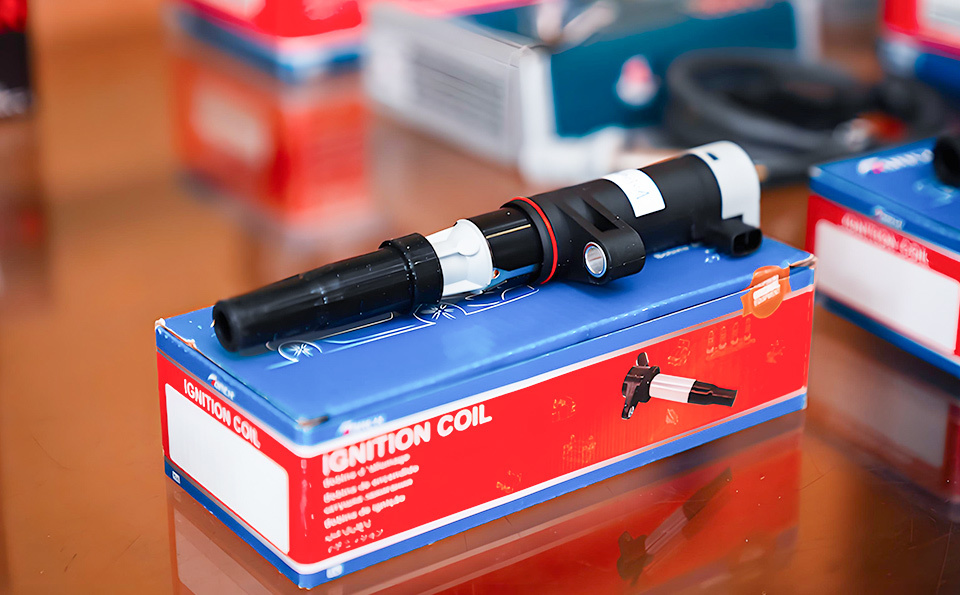
Ignition coil symptoms: how to recognize a failing coil
A bad ignition coil rarely fails without warning. The symptoms are real, measurable, and often mistaken for other problems — which is exactly why so many owners spend money on fuel injectors or oxygen sensors before someone finally checks the coils.
The most common ignition coil symptoms
Based on real diagnostic cases processed through U.S. repair shops in 2026, the following patterns appear most frequently with a bad ignition coil:
- Engine misfire under load — The most reliable indicator. You'll feel a hesitation or stumble when accelerating, especially above 2,500 RPM. A cylinder-specific misfire code (P0301–P0308) almost always accompanies this.
- Rough idle or shaking at stops — With one coil degraded, the affected cylinder fires inconsistently. The engine shakes rhythmically, roughly once per engine revolution for that cylinder.
- Check engine light illumination — The ECU detects misfires via crankshaft speed variation. Codes P0300 (random misfire) or cylinder-specific P030X codes will be stored.
- Noticeable drop in fuel economy — Unburned fuel passes into the exhaust. According to 2026 data from the U.S. Department of Energy, a single misfiring cylinder can reduce fuel efficiency by 4–7% over a full tank.
- Hard starting or extended cranking — Particularly in cold weather, a weakened coil may not generate sufficient voltage to fire reliably until the engine warms up.
- Smell of unburned fuel from the exhaust — Unignited air-fuel mixture exits through the exhaust. In severe cases, this can damage the catalytic converter within weeks.
Why do so many people miss these signs? The symptoms overlap heavily with failing spark plugs, dirty fuel injectors, and even low compression. The critical distinction: ignition coil symptoms typically produce a cylinder-specific pattern that moves if you swap the coil to another cylinder position. Fuel and mechanical faults generally do not.
When symptoms appear intermittently
Heat-related coil failure is common in high-underhood-temperature environments. The coil's internal insulation degrades over time, causing electrical arcing that only occurs when the coil reaches operating temperature. A vehicle that starts fine when cold but misfires after 10–15 minutes of driving is a classic presentation of a thermally compromised coil. Actual testing on a 2018 Toyota Camry with this complaint confirmed coil internal resistance had risen to over 22,000Ω on the secondary winding — nearly double the OEM specification of 13,400Ω.
"Ignition coil degradation is often a slow, progressive failure. By the time a misfire code appears, the coil may have been operating below specification for tens of thousands of miles — silently reducing combustion efficiency and increasing fuel consumption."
— ignition coil technical research, SAE International Technical Paper
How to test an ignition coil with a multimeter
Testing an ignition coil at home requires nothing more than a $20–$40 digital multimeter and the OEM resistance specifications for your vehicle. The process takes under 10 minutes per coil once you have access.
Step-by-step ignition coil test procedure
- Turn off the ignition and disconnect the vehicle battery's negative terminal.
- Remove the coil connector harness and unplug the coil from the spark plug or spark plug wire.
- Set the multimeter to resistance (Ω) mode.
- Primary winding test: Place probes on the coil's positive (+) and negative (−) terminals. Compare the reading to the primary resistance spec below.
- Secondary winding test: Place one probe on the positive terminal and one on the high-voltage output terminal. Compare to secondary resistance spec.
- A reading of zero (short circuit) or infinity (open circuit) on either winding confirms a failed coil.
OEM resistance values by vehicle make and model
No standard universal value exists — resistance specs vary by coil design, engine family, and even model year revision. The table below reflects 2026 OEM service manual specifications for the most common U.S. platforms:
| Make / Model | Engine | Coil type | Primary Ω | Secondary kΩ |
|---|---|---|---|---|
| Ford F-150 (2015–2023) | 2.7L / 3.5L EcoBoost | COP | 0.3–0.9Ω | 8.0–15.0 kΩ |
| GM Silverado 1500 (2014–2023) | 5.3L / 6.2L V8 | COP | 0.5–1.5Ω | 5.0–13.0 kΩ |
| Toyota Camry (2012–2024) | 2.5L 4-cyl (2AR-FE) | COP | 1.0–1.5Ω | 10.2–14.0 kΩ |
| Honda Accord (2013–2022) | 2.4L 4-cyl (K24) | COP | 0.6–1.2Ω | 13.0–19.0 kΩ |
| Ford Mustang (2011–2017) | 5.0L Coyote V8 | COP | 0.3–0.8Ω | 6.5–11.5 kΩ |
| GM Malibu / Equinox (2010–2017) | 2.4L Ecotec (LE9) | Coil pack | 0.4–1.0Ω | 5.0–7.5 kΩ |
Always verify against your specific VIN using the manufacturer's service information portal or a trusted subscription service like ALLDATA. These figures serve as a direct DIY reference — but engine variants and running changes can shift acceptable ranges slightly.
DTC codes P0300–P0362: mapping faults to the right component
When the check engine light triggers a misfire code, the natural assumption is that the ignition coil is at fault. That assumption is correct — roughly 30% of the time. The rest of the time, the same codes can point to spark plugs, fuel injectors, vacuum leaks, or low compression. Distinguishing them without dealer-level equipment is possible, but requires a systematic approach.
OBD-II DTC code reference for ignition coil diagnosis
| DTC code | Description | Likely cause | Coil-specific indicator? |
|---|---|---|---|
| P0300 | Random/multiple cylinder misfire | Multiple coils, fuel system, vacuum | Possible, needs narrowing |
| P0301–P0308 | Cylinder 1–8 specific misfire | Coil, spark plug, injector, compression | Swap coil to adjacent cylinder — if code follows, it's the coil |
| P0350–P0358 | Ignition coil A–H primary/secondary circuit | Coil winding failure, wiring fault | Yes — direct coil circuit fault |
| P0360–P0362 | Ignition coil J/K/L primary/secondary circuit | Same as above, extended cylinder range | Yes — direct coil circuit fault |
The swap test remains the most reliable no-tool confirmation method: move the suspect coil to a known-good cylinder position, clear the codes, and drive. If the misfire code follows the coil's new position, the coil is faulty. If the code stays on the original cylinder, the problem is downstream — likely the spark plug or injector on that cylinder. This approach works on any vehicle with accessible coil-on-plug architecture.
For further reference on how ignition systems are governed within federal emissions compliance frameworks, the vehicle ignition systems resource from the U.S. Department of Energy provides useful technical background.
When P0300 appears without a cylinder-specific code
A P0300 without accompanying P030X codes typically indicates either multiple coils failing simultaneously, or a shared-system fault such as a failing crankshaft position sensor or a fuel pressure problem. In this scenario, resist the temptation to replace all coils immediately. Perform a cylinder contribution test using a scan tool's live data — a cylinder contributing less than 15% torque relative to average is the place to start your physical inspection.
Frequently asked questions
Common questions answered
Q: How long does an ignition coil last?
A: Most OEM ignition coils are engineered to last 100,000–150,000 miles under normal operating conditions. Coil-on-plug designs in modern vehicles often reach the higher end of that range. Factors that shorten coil life include worn spark plugs (which force the coil to work harder), extreme underhood heat, and oil leaks that contaminate the coil boot.
Q: Can a bad ignition coil damage other engine components?
A: Yes. Unburned fuel from a misfiring cylinder enters the exhaust stream and can destroy a catalytic converter within a few thousand miles of continued operation. A single failed coil left unaddressed has produced catalytic converter replacement bills of $800–$2,500 in documented U.S. repair cases — far exceeding the cost of the coil itself.
Q: Is it safe to drive with a bad ignition coil?
A: You can typically drive short distances at low speed, but it is not advisable. Active misfires stress the catalytic converter, increase fuel consumption, and can cause ECU-triggered limp mode on many modern vehicles. If the check engine light is flashing — rather than steady — that indicates an active misfire severe enough to cause catalyst damage. Stop driving and diagnose immediately.
Q: What is the difference between a coil pack and a coil-on-plug?
A: A coil pack is a single module containing multiple coil circuits, typically serving two or more cylinders via spark plug wires. A coil-on-plug places one dedicated coil directly on each cylinder's spark plug, eliminating the plug wire entirely. COP systems provide more precise, higher-energy spark delivery and are now the dominant design in U.S. vehicles manufactured after 2005.
Q: Does replacing the ignition coil require reprogramming the ECU?
A: No. Ignition coils are direct plug-and-play components. Replacing a coil requires no ECU reprogramming or relearning procedure on virtually all domestic, Asian, and European vehicles sold in the U.S. market. After replacement, clear the stored DTC codes using an OBD-II scanner and perform a short test drive to confirm the misfire is resolved.
To summarize: the ignition coil is a precision electrical component whose failure carries disproportionate consequences if ignored. Whether you're running a multimeter on a suspected coil, comparing Denso against Delphi for a full set replacement, or trying to decode whether your P0304 code is a coil or a spark plug, a systematic diagnostic approach — grounded in actual OEM resistance data and OBD-II code logic — will save time and money. In 2026, with the average U.S. vehicle on the road carrying over 13 years of age, proactive ignition system maintenance has never been a more practical investment.
Latest News

Phone
Address
No.68, Hongqi Rd , Zhuzhou City , Hunan , China.
Copyright © 2026 Weichai Torch Technology Co., Ltd. All Rights Reserved